Most businesses have a LinkedIn presence. A company page, maybe a few personal profiles, posts that go out occasionally - a team photo, a shared blog post, a congratulations to someone who's just been promoted. And then nothing happens. No engagement worth mentioning, no enquiries, no conversations that go anywhere useful.
The natural conclusion is that LinkedIn doesn't work for their industry. Or that organic reach is dead. Or that you need tens of thousands of followers before the platform does anything for you.
None of that is true. LinkedIn is working, just not for businesses using it as a broadcast channel. The businesses generating consistent B2B leads from LinkedIn are using it completely differently. Here's what that actually looks like.
Before getting into the how, it's worth being clear on the why, because LinkedIn's commercial case is stronger than most businesses realise, and most are leaving it on the table.
Organic reach on LinkedIn is still disproportionately high compared to almost every other social platform. A well-constructed post from a personal profile can reach thousands of relevant people without any paid amplification. On Facebook or Instagram, that kind of reach requires budget. On LinkedIn, it's still available to anyone willing to show up consistently and post something worth reading.
The audience is also right. LinkedIn skews heavily toward senior professionals, business owners, and decision-makers. The person who can say yes to working with you is more likely to be on LinkedIn than on any other platform. And more likely to be in a receptive, professional mindset when they're there. That's a combination that's genuinely rare.
The bar can be quite low too. Most businesses are using LinkedIn badly. Sporadic posting, company-page-only presence, zero engagement with anyone else's content. In most sectors, showing up consistently and intelligently is enough to stand out, because the competition isn't doing it.
The opportunity is real. But it requires a different approach to the one most businesses are currently taking.
The reason most businesses get nothing from LinkedIn is not the platform. It's the approach.
Most businesses use their company page as the primary presence. That's the first mistake. Company pages have significantly lower organic reach than personal profiles. LinkedIn's algorithm consistently favours content from people over content from brands. Posting exclusively from a company page and expecting meaningful reach is like sending emails from a no-reply address and wondering why nobody responds.
The content compounds the problem. Company announcements, blog shares, award nominations, new starter posts. None of it gives the reader a reason to engage, follow, or get in touch. It's content written for the business, not for the audience.
Then there's the consistency problem. Three posts in January, nothing in February, two in March. LinkedIn's algorithm rewards accounts that show up regularly and penalises those that disappear. Inconsistency doesn't just mean fewer posts. It means less reach on every post.
And finally, there's no conversation. Posting and disappearing is not a strategy. The businesses generating leads from LinkedIn are engaging with other people's content, responding to comments and starting conversations. Not just broadcasting into the void and hoping something lands.
The fix isn't complicated. But it does require a deliberate change in approach.
There are six things that separate businesses generating real pipeline from LinkedIn from those that aren't.
Most LinkedIn profiles are written like a CV. Job titles, responsibilities, a career history that reads like a list of things the person has done. That's not what a potential client needs to see.
A profile that generates leads answers three questions immediately: what do you do, who do you do it for, and why should someone talk to you? The headline, the about section, and the featured section all need to do this work clearly and quickly.
The headline is the most important element. "Managing Director at Revolved" tells nobody anything useful. "We help B2B businesses generate more leads through paid media, SEO, and content - without wasting budget" tells the right person exactly whether they should keep reading. That's the difference between a profile that gets ignored and one that gets clicked.
The content that performs on LinkedIn is not company news. It's insight, opinion, experience, and honest takes on things the target audience actually cares about.
What works: a specific lesson learned from a client campaign, an honest take on why a common approach doesn't work, a short breakdown of something the reader can apply immediately, a contrarian view on something the industry takes for granted.
What doesn't work: "We're delighted to announce...", "Check out our latest blog post", "Happy to share that we've won...", generic motivational content with no commercial relevance to anyone.
Three to four posts per week from a personal profile is enough to build consistent reach. Quality matters more than volume. One genuinely useful post outperforms five forgettable ones every time.
The type most businesses are too afraid to post.
This is the section most LinkedIn guides skip. It's also where the real reach comes from.
The highest-performing LinkedIn content is rarely the most polished. It's personal, specific. and human. It works because it stops the scroll in a way that a company update never will.
Last year, I created a post that opened with "In the summer, someone called us 'too small'. Made me laugh." went on to tell a short story about a client whose conversion rate was stuck. Their "Contact Us" button took three clicks before you even saw a form. When you got there, it had five sections and up to twelve fields — just to request a callback. The fix was simple. A contact form on every page, slimmed down to five fields total. Done in a week. 97% increase in conversions.
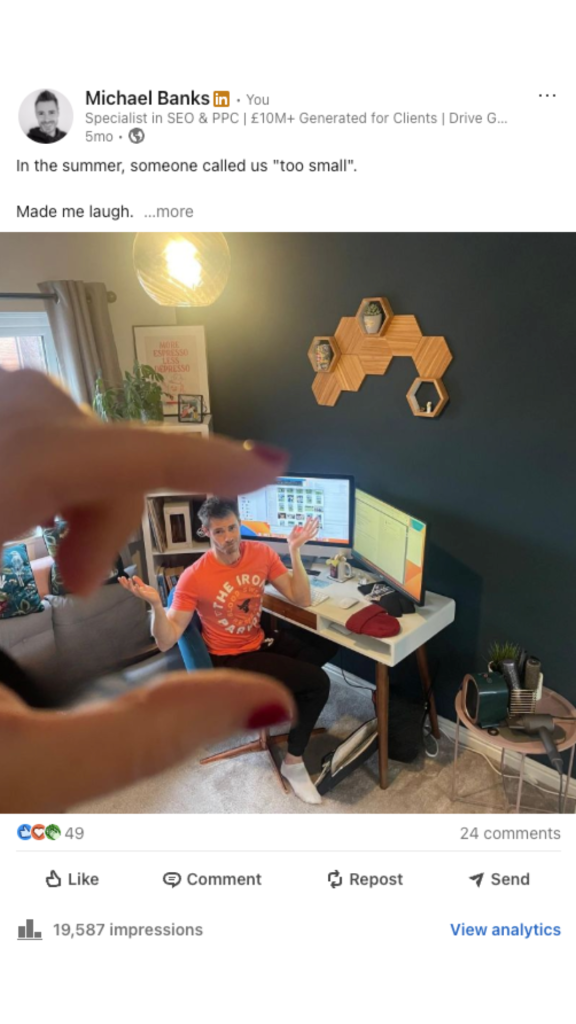
The point of it was to demonstrate that in my experience, a “small agency” is actually better than a “big, international agency”.
19,587 impressions. 24 comments. 49 engagements.
No budget. No design team. A candid photo and a few short paragraphs written honestly.
What made it work: a hook that was personal and unexpected, a short story with a clear commercial point, and a close that landed. That structure - personal hook, short story, commercial truth, punchy close - is repeatable. It consistently outperforms content that leads with the business rather than the person behind it.
This doesn't mean every post needs to be a confessional. It means the person behind the business needs to be visible. Opinions, experiences, things that went wrong, things that surprised you, moments that made you think differently. These are the posts that build an audience and, over time, build trust with the right people.
The businesses that are too corporate on LinkedIn. That sound too polished, too careful, too brand-managed, are the ones that get ignored. The ones willing to be a bit more human are the ones that get remembered.
A practical content mix: aim for roughly two to three personality-led or personal post for every one commercially focused post.
Follower count is less important than follower quality. A thousand connections who are all potential clients or referral partners is worth more than ten thousand connections who have no relevance to the business.
Be deliberate about who you connect with. Use LinkedIn's search filters to find the right job titles, industries, and company sizes. Send connection requests with a short, personalised note. Not a pitch, just a genuine reason for connecting.
Who to prioritise:
Content builds awareness. Conversations build pipeline. The businesses generating leads from LinkedIn understand that content is the top of the funnel, not the close.
When someone engages with a post, responds to a comment, or views a profile multiple times, that's a signal worth acting on. A short, genuine DM referencing something specific, not a templated pitch, is how content turns into a conversation.
What works in outreach: specific, relevant, short. Reference something they've posted, something you have in common, or a genuine observation about their business. What doesn't work: copy-paste pitches, immediate asks for a call, anything that reads like it was sent to five hundred people at once. People can tell. And they don't respond.
Personal profiles consistently outperform company pages on reach and engagement. LinkedIn's algorithm is built around people, not brands.
That doesn't mean the company page is useless, it provides credibility, houses the business's content archive, and appears in search. But it should be treated as a supporting presence, not the primary one.
The most effective approach: senior people in the business posting from their personal profiles, with the company page amplifying and sharing that content. The people are the channel. The company page is the backdrop.
Most businesses quit LinkedIn before it works. That's worth being honest about, because the early stages of a LinkedIn strategy feel unrewarding in a way that makes it easy to conclude the platform isn't working.
The first month of consistent posting will feel like shouting into an empty room. Reach will be low, engagement will be minimal, and it will be tempting to pull back. Don't.
It takes three to six months of consistent, quality posting before reach and engagement start to compound meaningfully. The accounts with significant LinkedIn presence didn't get there in a quarter, they got there by showing up consistently when it felt like nothing was happening.
LinkedIn rewards patience and consistency in a way that most paid channels don't. Every post builds on the last. Every conversation opens a door. Every piece of content adds to a body of work that makes the next piece land better. Here's what a realistic timeline looks like:
The businesses that treat LinkedIn like a campaign, something to run for a quarter and evaluate, consistently get less from it than the ones that treat it like a channel with a compounding return.
LinkedIn in 2026 is not a vanity channel. For B2B businesses, it's one of the most cost-effective lead generation tools available, if it's used properly.
The businesses winning on it aren't the ones with the biggest following or the biggest budget. They're the ones showing up consistently, posting content that's genuinely useful, letting some personality through, and treating conversations as the point, not the afterthought.
The gap between a business using LinkedIn properly and one using it as a notice board shows up in brand awareness, in inbound enquiries, and in the quality of relationships being built with the right people over time.
The channel is there. The audience is there. The question is whether the approach matches the opportunity. And for most businesses, it doesn't yet.