SEO's not dead. But a lot of the stuff people still obsess over is.
AI Overviews, ChatGPT, zero-click search. Yes, things are definitely shifting. Google's using your content not just to rank pages, but to generate answers. User expectations have changed. And the old playbook of "stuff keywords in and hope" stopped working years ago.
But guess what? SEO still works. It's just rewarding different things now. If you're trying to grow without wasting budget, you need to focus on the few things that reliably move rankings and revenue in 2026. And drop the rest!
Here are the ranking factors that matter most going into the new year, and what you should actually do about them.
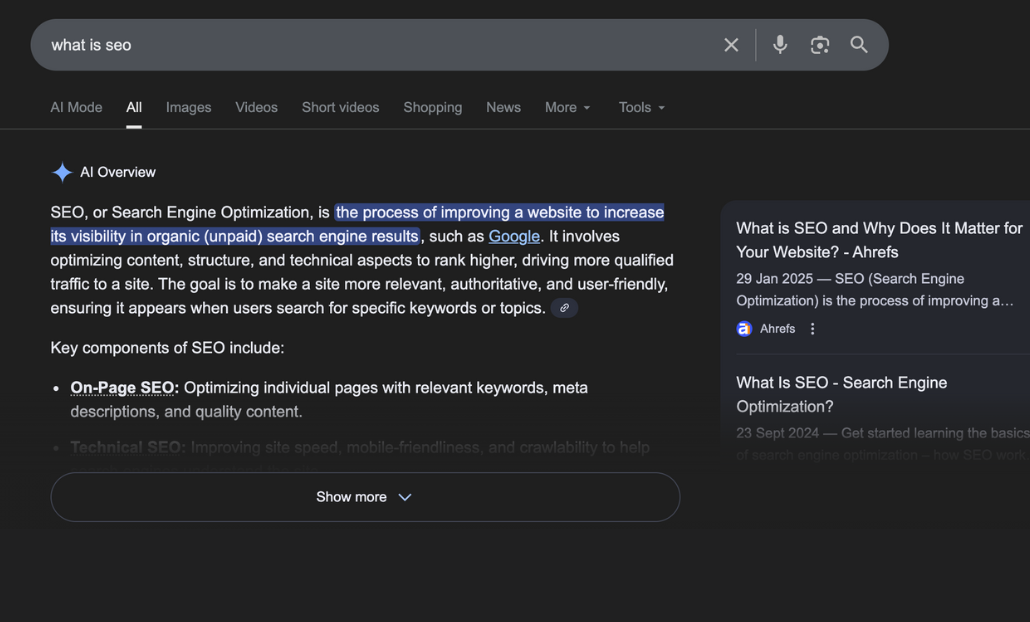
AI Overviews aren't going anywhere. Google's increasingly using your content not just to rank, but to respond. The easier your content can be summarised, cited and trusted by AI systems, the better your organic visibility.
If your content is vague, poorly structured, or buried under fluff, it won't get picked up. And if it doesn't get picked up, you're invisible — even if you technically "rank".
Yes, AI Overviews have caused a decline in organic traffic for some sites. But that's because they're answering simple questions directly in the SERPs. The solution isn't to panic — it's to evolve. Create content that goes deeper, offers more value, and gives people a reason to click through.
Google's cracking down on thin, generic content, especially the kind that's clearly been churned out without any real-world experience behind it.
The first "E" in E-E-A-T (Experience, Expertise, Authoritativeness, Trustworthiness) is becoming one of the most influential ranking signals. Google wants to see that real people with real knowledge are behind your content.
If your content feels like it could've been written by anyone, anywhere, it's not going to cut it in 2026.
Google's far better now at interpreting when a user feels satisfied by a page. It watches what people do after they click. And it uses that data to decide whether your page deserves to rank.
The key behavioural signals include:
If people land on your page and immediately leave, or if they have to re-search to find what they need, Google notices. And your rankings suffer.
No matter how good your content is, if your site's slow, clunky, or frustrating to use, you won't rank well.
Google's Core Web Vitals are continuously evolving. The next phase goes beyond just load speed, they care about the quality of user interactions, especially in the first few seconds.
If you’re not sure where your site stands, run it through Google’s PageSpeed Insights. Fix the red flags first.
This one has been around a while, but it’s a big one that so many “experts” still don’t do!
Google hasn't just looked at keywords for a long time. It understands concepts, relationships, and context.
In 2026, Google expects your content to cover topics in depth, not just hit a keyword and move on. That means building topic clusters, interlinking related content and creating "knowledge paths" that guide users (and search engines) through a subject.
So, what does this looks like in practice?
Instead of isolated blog posts, you build a central "pillar" page on a broad topic, then support it with multiple sub-pages that each explore specific aspects. All interlinked.
For example, if you're targeting "eCommerce SEO", your pillar page covers the overview. Then you create supporting pages on product page SEO, category page SEO, technical SEO for eCommerce, etc. Each one links back to the pillar and to each other where relevant.
This structure helps Google see your site as an authority on the topic and it improves your ability to rank for a wider range of queries.
Your content should be connected so users can easily move from one idea to the next along a logical learning journey. This helps search engines understand the full context of your content and signals that your site offers comprehensive coverage.
Text, images, video, audio. Google's AI models are designed to process multiple content formats simultaneously. Multi-modal content improves user experience, boosts engagement and increases your chances of appearing in Rich Results (featured snippets, image carousels, video carousels).
Search engines now map brands as entities, complete with attributes, relationships and trust signals. The stronger your entity, the better your topical authority.
Your SEO performance is no longer driven only by what you publish on your own site. It's driven by what the internet says about you. That means, if the web reflects brand authority, you get surfaced more. If the web reflects uncertainty or invisibility, you fade out.
In short - SEO has become more and more about reputation management at scale.
Search engines and AI systems rely on clear formatting and structured data to understand, categorise and confidently use your content in rankings, AI-generated answers and Rich Results (like ‘People Also Asked’).
If your content is a wall of text with no structure, it's harder for Google to parse. And harder for AI to cite.
Schema types with increasing impact include FAQ, How-To, Product and Review schema. Author and Organisation schema help build trust and authority, while VideoObject and ImageObject schema support multi-modal indexing.
Google's freshness model is becoming more sophisticated all the time. And 2026 is no different. Gone are the days of adjusting publish dates or timestamps and hoping for the best.
You need to make real updates to your content. Fresh data, rewritten sections, new insights and updated examples.
Every industry moves at a different pace, but generally, trends shift quickly and product offerings evolve over time. There should always be content to update.
Particular attention should be paid to content containing dates (like this post) or current trends. If it's out of date, it's hurting you.
AI-generated content isn't penalised. But low-value, generic content is just completely devalued, whether it's written by AI or a human.
AI is brilliant for drafting and ideation. It can save you a lot of time and energy. But copy-pasting straight from ChatGPT isn't going to cut it. You need to add human depth, nuance, anecdotes, real-life examples and original data. You also need to protect your brand identity by maintaining a consistent brand voice across all content.
Add proof points like data, case studies and screenshots. Whatever backs up your claims. The goal isn't to avoid AI. And your goal shouldn't just be to use only it. AI is tool to use, not a replacement for thinking.
Review platforms matter more every year. For local and eCommerce SEO, this may be the biggest ranking factor shift heading into 2026. Google, Trustpilot and industry-specific directories; they all feed into how search engines evaluate your brand's trustworthiness.
Not everything that used to matter still does. Here's some things that you can safely ignore or spend less time on.
You can't do everything. But here's how to choose:
SEO still works. It’s still relevant. It’s just evolved again. But you do need to focus on what moves the needle. The things that matter most in 2026:
The bottom line is the core of SEO in 2026 hasn’t changed. It isn't about doing more; it's about doing the right things. AI has raised the bar for content quality and user experience, but it's also created new opportunities for brands that can demonstrate real expertise and build authority beyond their own website.
If you're resource-constrained (and who isn't), focus on what's closest to revenue first: fix what's broken, optimise your money pages, and build a reputation that Google can verify across the web. The brands that'll win this year are the ones that stop chasing vanity metrics and start treating SEO as what it really is — a long-term investment in being found, trusted, and chosen.
Want to set your site up for SEO success in 2026? We can audit your site and show you the 3–5 things that'll make the biggest impact. Get in touch!