Your boss has seen a headline. Your team's got questions. And someone's probably asked, "Is SEO even worth it anymore?"
The reality is, AI search is live and growing. Google AI Mode is already rolled out across the UK, US and most of Europe. Platforms like ChatGPT, Claude, Deepseek and Perplexity are being used by millions of people every day to research products, compare services, and make decisions.
But here's what matters. This isn't replacing traditional search. It's adding a new layer.
If you're trying to explain what's happening to stakeholders without causing panic or promising the world, this article will help. We'll cover why AI search matters, what it means for your brand, and the practical steps you can take to prepare.
For decision-makers like CEOs, CMOs and investors, AI search can feel like a technical detail. But the impact goes right to the heart of brand visibility and trust.
Think about the difference in user behaviour.
In Google's classic search results, a customer might click three or four different links to compare information. They'll visit your site, a competitor's site, maybe a review platform, then make a decision.
In AI Mode or ChatGPT, they often receive one summarised answer. If your business isn't cited in that response, you're effectively invisible at the point of decision.
That doesn't mean SEO is losing value. It means SEO and Generative Engine Optimisation (GEO) need to be treated as complementary strategies.
SEO ensures your site ranks in search results. GEO ensures your brand is represented in AI-generated answers.
Framing it this way helps stakeholders see that this isn't a fad. It's a structural change in how people find businesses. And the brands that prepare early will have a significant advantage over those that wait.
We’ve built a clear seven-step framework that brands can use to prepare. Each step strengthens both your SEO and GEO, which is why they work so well together.
The simplest way to measure your current visibility is to test it yourself.
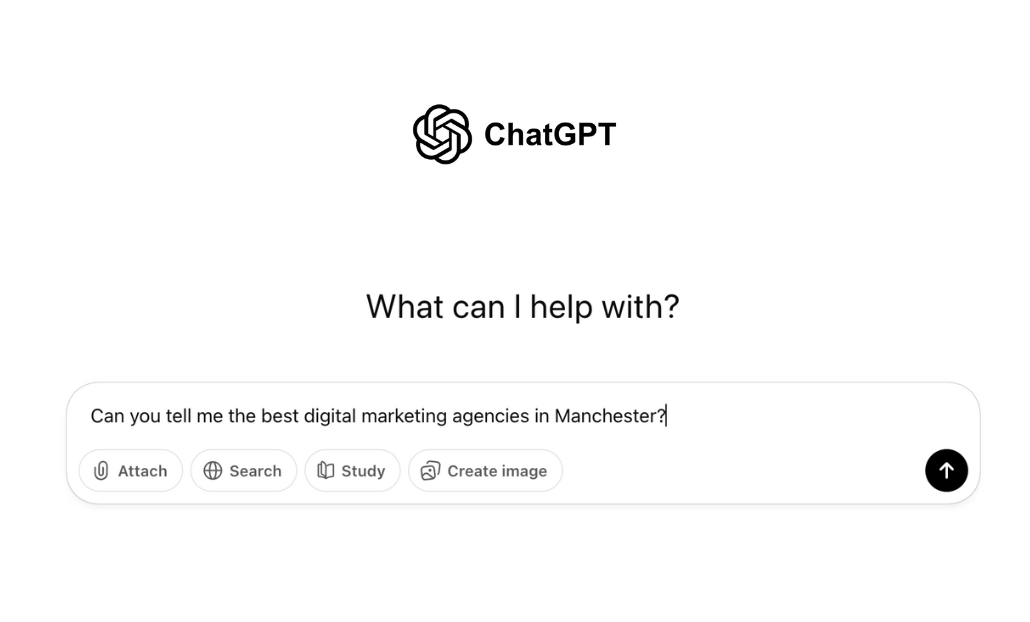
Go to ChatGPT, Perplexity, or Google AI Mode and ask:
If the AI gives vague responses or doesn't mention your brand, that tells you your signals aren't strong enough yet.
This is also one of the best ways to make stakeholders pay attention. Show them a live example where your competitors are being cited and your business is missing. It turns the conversation from theory into a clear business gap.
You can do this in a meeting. Pull up ChatGPT on the screen, ask the question, and let them see the results in real time. It's far more effective than a slide deck.
Don't stop at your homepage.
Look at how your business appears across the wider web:
AI engines scan all of this when forming answers. If your brand looks inconsistent, outdated, or unclear, you reduce the likelihood of being cited.
Stakeholders will quickly see that this isn't just a technical SEO issue. It's about brand consistency and clarity. The same messages need to be consistent across all touchpoints.
If your LinkedIn says one thing, your website says another, and your Google Business Profile says something else entirely, AI tools won't know which version to trust, so they'll often just leave you out.
SEO has always treated backlinks as the gold standard for authority. AI search engines are slightly different. They value brand mentions, even when those mentions aren't linked.
This is why digital PR, thought leadership, and brand-building campaigns have taken on new importance.
Examples include:
For stakeholders, this highlights the need for investment beyond technical SEO. Authority is built in the wider ecosystem, and AI search engines are designed to reflect that.
If the internet says you're an authority, AI tools will treat you like one. If the internet barely mentions you, you'll struggle to appear in AI-generated answers, even if your website is technically perfect.
Confusion is the enemy of AI summaries.
If your website has duplicated service pages, blog posts that don't align with what you sell, or a navigation that makes it hard to work out who you serve, AI engines will struggle to summarise you.
Clear content structure helps in two ways:
This is a win-win that stakeholders can get behind. Improving clarity not only prepares you for AI search, it also boosts conversion rates.
Practical things to check:
If the answer to any of these is "not really", that's where you start.
Structured data (schema markup) helps search engines and AI tools connect the dots. It's been a staple of traditional SEO for the last 10 years.
For example:
You’re not gaming the system. You’re giving AI tools accurate signals to work with.
Stakeholders should see schema as the infrastructure that supports everything else you do in SEO and GEO. Without it, you're making it harder for AI to understand and cite your content.
If you're not sure whether your site has schema markup, you can check using Google's Rich Results Test or ask your developer. If it's missing, it's worth adding. Especially for key pages like your homepage, service pages, and FAQ sections.
One of the most noticeable shifts with AI search is the type of queries it handles well. These are usually research-stage questions, such as:
If your content answers these questions in depth, you increase your chances of being cited.
This also highlights where stakeholders should invest in content creation. It's not only about sales pages. It's about building trust at the research stage so your brand is part of the conversation from the start.
Practical approach:
The goal isn't to write a 3,000-word essay. You need to give a clear, helpful answer that AI tools can confidently cite.
One of the most overlooked tactics is also one of the simplest: create content that clearly explains who you are and how you work.
Examples include:
These pages convert visitors into customers, but they also help AI engines understand your positioning. If this content doesn't exist, AI tools are forced to guess based on scattered signals.
Stakeholders should see this as a low-cost, high-value investment. A few clear pages can have a major impact on both AI visibility and conversion rate.
And if you already have these pages, make sure they're up to date. If your "Why choose us" page was written in 2019 and hasn't been touched since, it's probably not doing you any favours.
The reality is that most stakeholders don't need to know the technical details of schema markup or crawlability.
What they do need is a clear understanding of why visibility in AI search matters and what role they play in preparing for it.
SEO is still essential. Without a solid SEO foundation, you won't perform in traditional or AI-driven search. Everything we've built over the years still matters.
GEO is the next layer. Generative Engine Optimisation makes sure you're visible when people use new tools to research. It's not a replacement — it's an addition.
Authority is business-wide. PR, brand clarity, and thought leadership are not side projects. They directly impact how your brand is represented in search. Marketing can't do this alone — it needs buy-in from leadership, sales, and product teams.
This is a gradual rollout. AI Mode and LLMs are expanding incrementally. There's time to prepare, but it is speeding up all the time. So you need to get started now if you haven’t already. The brands that wait until "everyone's doing it" will be playing catch-up.
The cost of doing nothing is invisibility. If your competitors are being cited in AI answers and you're not, you're losing consideration at the earliest stage of the buyer journey. That's hard to recover from.
Stakeholders will want to know what "good" looks like. Here's how to set expectations:
The key message is this isn't a quick fix. It's a strategic shift that requires consistent effort. But the brands that are doing it now will have a significant advantage.
AI search is here. Trust us, it’s not replacing SEO, but it's adding to it. And if you're trying to explain this to stakeholders, the key is to focus on the business impact - visibility, trust and being part of the consideration set from the start. The seven steps we've covered aren't complicated, but they do require action.
Start by testing your visibility. Ask ChatGPT, Perplexity, or Google AI Mode what they know about your brand. Show stakeholders the gap. Then build a plan to close it. This isn't chasing the latest trend or overhauling everything you've built. AI is here to stay. Businesses need to adapt about to how people are actually searching and making decisions now. Just like we did with social platforms.
The brands that prepare early will have a significant advantage. The ones that wait will be playing catch-up. And in a world where AI tools cite just a handful of sources, being left out means being invisible.