You check Google Search Console and your rankings look fine. Page one for most of your key terms. Nothing's dropped. Nothing looks broken.
But traffic is down. Or it's flat when it should be growing. Or the clicks just aren't matching the impressions the way they used to. You're showing up, you can see that clearly enough, but fewer people are actually arriving on your site.
If that sounds familiar, there's a good chance AI Overviews are part of the story.
This isn't a niche technical problem that only affects big publishers or content-heavy websites. It's something that's quietly affecting businesses across almost every sector — and most of them don't fully understand what's happening, let alone what to do about it. This post explains it in plain English, tells you honestly who's most at risk, and gives you practical steps to take if you're concerned about where your organic traffic is heading.
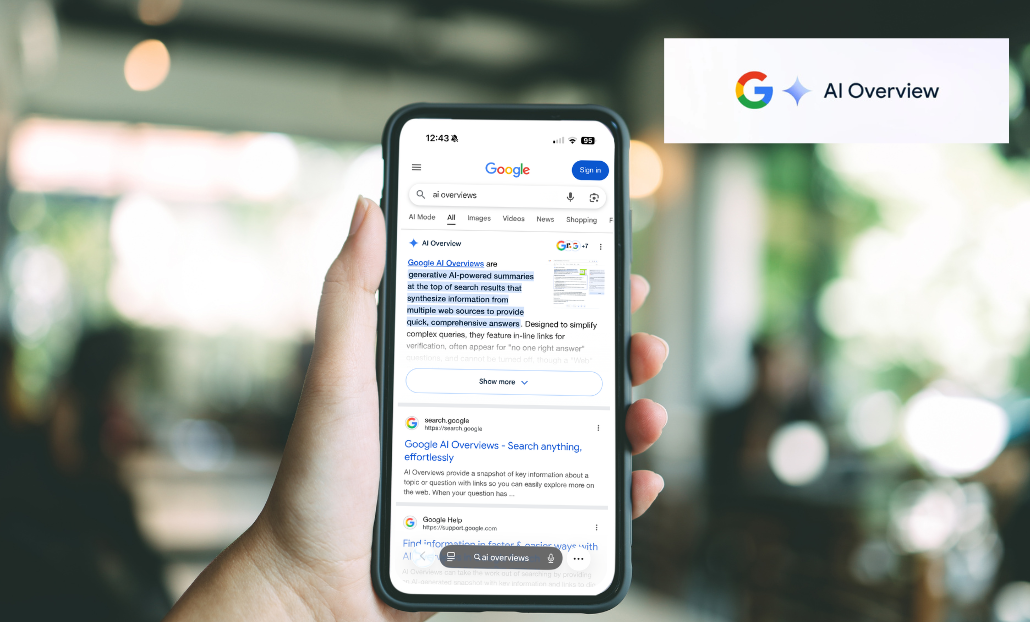
When you search for something on Google now, you'll often see a box at the very top of the results page before any of the traditional blue links, that gives you a summarised answer to your question. That's an AI Overview.
Google is generating that answer itself, pulling information from multiple sources across the web and presenting it in one place. The idea, from Google's perspective, is to give users what they need as quickly as possible. A better experience. Faster answers. Less clicking around.
The problem, from a business owner's perspective, is obvious. If someone gets their answer from that box at the top of the page, they have no reason to click through to your website. Your content may have contributed to the answer. Your brand might even be cited as a source. But the visit and everything that comes with it, never happens.
This isn't entirely new territory. Google has been doing a version of this with featured snippets for years, pulling a paragraph or a list from a single page and displaying it prominently at the top of the results. If you've ever searched for something and got the answer without clicking anywhere, you've experienced it.
But AI Overviews are a significant step up from that. They're more comprehensive, more prominent, and far more capable of fully answering a question in one go. Which means more people get what they came for without ever visiting a website.
That's what zero-click search means. A search that ends on the results page. No click. No visit. No traffic to your site.
And it's more common than most people realise. Research suggests that well over half of all Google searches now end without a click to any website. That number has been climbing steadily for years, driven first by featured snippets and knowledge panels, and now accelerated significantly by AI Overviews. For businesses that built their online presence around organic search traffic, that's a meaningful shift. And it's not going to reverse.
The important thing to understand, though, is that this doesn't affect every business equally. Not every search triggers an AI Overview. Not every type of content is equally exposed. And understanding the difference is what determines whether this is a serious problem for your business or something you can largely navigate around.
This is the part most articles on this topic skip over, and it's the most useful thing to understand if you're trying to work out how worried to be about your own traffic.
The businesses most at risk are those that rely heavily on informational, top-of-funnel content. How-to guides, definitions, explainers, "what is X" articles, "how does X work" posts — the kind of content that answers a clear, straightforward question. If Google can now answer that question itself, in a prominent box at the top of the page, a significant proportion of the people who would previously have clicked through to your article simply won't. They got what they needed. There was no reason to go further.
Publishers and content-heavy sites that built their entire model around traffic volume are feeling this most acutely. But it also affects any business, agency, retailer, service provider that built its SEO strategy around producing informational content to attract awareness-stage visitors. If that content was answering questions that Google can now answer itself, the traffic it was generating is at risk.
The businesses least affected are those where the intent behind the search is commercial or transactional, where the user needs to actually visit a website to do anything useful.
The honest take is this: if your traffic was built on thin informational content that answered simple questions, that traffic was always fragile. AI Overviews have accelerated the decline, but they didn't create the underlying problem.
The businesses most exposed are the ones that built their SEO strategy around volume rather than genuine value and the ones that will adapt most successfully are the ones willing to be honest about that.
Here's something that catches a lot of people off guard, and it's worth spending a moment on because it changes how you should think about what success looks like in search.
Your content can be cited as a source inside an AI Overview. Google considers it authoritative and trustworthy enough to pull from. And you can still see fewer clicks as a result. The user read the summary, saw your brand name mentioned, got the answer they were looking for, and moved on. No visit. No session in GA4. No conversion opportunity.
On the surface, that feels like a bad deal. You did the work, Google used it, and you got nothing back. And in terms of raw traffic numbers, that's a fair way to look at it.
Being cited in AI Overviews builds brand awareness at scale. Someone who sees your name referenced as a source, even without clicking, is more likely to recognise it the next time they encounter it. It signals to Google that your content is trustworthy and authoritative, which has a positive effect on how your site is treated more broadly.
And for the users who want to go deeper, those who read the summary and think "I want to understand this properly", your link is still there. Those tend to be higher quality visits from people with genuine intent.
This is the visibility paradox. More visible in one sense, less traffic in another. The implication is that optimising to be the source Google pulls from is now a legitimate goal in its own right. Not just a nice side effect of ranking well, but something worth actively building towards.
This is where most articles on this topic let you down. They explain the problem clearly enough, then offer advice so vague it's almost useless. "Create better content." "Focus on quality." "Build authority." None of that tells you what to actually do on Monday morning.
Here's something more specific.
If a meaningful chunk of your organic traffic comes from informational content that answers questions Google can now answer itself, that part of your strategy needs to evolve. Not disappear; evolve.
The shift is from "answer the question" to "go further than the answer." Add context that a summary can't replicate. Share a genuine opinion on the topic. Draw on real experience from actual client work or real situations. Give examples that are specific enough to be genuinely useful rather than generically illustrative. The more your content reflects real expertise and human experience, the less replaceable it is by AI Overviews or anything else.
A post that says "here are five things to consider when choosing an SEO agency" is replaceable. A post that says "here's what we've seen go wrong when clients choose the wrong agency, and here's the specific question you should ask before signing anything" is not. The information might overlap. The experience behind it doesn't.
Product pages, category pages, comparison content, buying guides, "best X for Y" content, content that exists to help someone make a purchase decision rather than just learn something. These queries are far less affected by AI Overviews because the user still needs to visit a website to do anything useful with the information.
If your content mix is currently weighted heavily towards informational content, it's worth rebalancing towards content that sits closer to the point of purchase. Not at the expense of informational content entirely, that still has a role, but as a deliberate shift in where you're putting your effort.
If Google is going to summarise answers at the top of the page, you want to be the source it pulls from. That means a few specific things:
This isn't about abandoning SEO. It's about not having all your eggs in one basket, which if we're honest, is advice that's always been true but that a lot of businesses have ignored because Google traffic was reliable enough not to worry about.
Email lists, social media, direct traffic, partnerships, communities - channels you own or control that aren't affected by changes to how Google displays its results page. A business with a strong, engaged email list is far less exposed to algorithm changes and AI Overview rollouts than one that relies entirely on organic search. If you don't have a channel you own, building one should be on the list.
This one is practical and immediately actionable. Impressions going up while clicks go down is a classic sign of the zero-click effect, not a ranking problem. If you're only looking at overall traffic volume, you might be missing what's actually happening beneath the surface.
Separate your informational traffic from your commercial traffic in your reporting. They tell very different stories. A drop in traffic to a "what is X" article matters a lot less than a drop in traffic to a product category page or a service page. Focus on conversions and revenue from organic, not just the headline traffic number, because that's the number that actually tells you whether your SEO is working for your business.
The traffic isn't coming back. Not the easy, high-volume, answer-a-simple-question traffic that Google used to hand out freely. That ship has sailed, and AI Overviews have made sure of it.
Google's changed the game. The question is whether you're going to change with it.
The businesses that will struggle are the ones that carry on doing the same thing and hope the numbers recover. The ones that will do well are the ones creating content with genuine depth and real experience behind it, targeting the right intent, and building the kind of authority that Google trusts enough to cite at the top of the page.
Do you actually know which of your pages are most exposed right now? Because the businesses that find out now and adapt have a real head start over the ones that wait until the drop is impossible to ignore.